
Saving KG: Rewriting T-Wolves History

This is where to post any NBA or NCAA basketball franchises.
User avatar

Topic author
NaturalThunder87
Posts: 160
Joined: 23 Mar 2026, 23:40

Saving KG: Rewriting T-Wolves History

Post by NaturalThunder87 » 14 Jul 2026, 16:46

Image

Born in the late '80s and raised in Arkansas, I never really had one NBA team that I called my team. Instead, I followed players. My earliest basketball memories are of Michael Jordan's second three-peat, but once Jordan stepped away, one player grabbed my attention more than anyone else: Kevin Garnett.

KG quickly became my favorite player, with Allen Iverson and Dirk Nowitzki not far behind. I followed him religiously throughout his career, and when he was traded to Boston in the summer of 2007, 20-year-old me instantly became a Celtics fan.

Over the years, one question has always stuck with me:

What if the Timberwolves had actually built a contender around Kevin Garnett?

For all of KG's brilliance, Minnesota's front office repeatedly failed him. Poor roster construction, questionable personnel decisions, and the infamous Joe Smith scandal squandered much of one of the greatest primes in NBA history.

This MyNBA is my attempt to rewrite that history.

I'm beginning in the 1995-96 season, Garnett's rookie year, with one goal: build a championship team the way Minnesota never did. That means no baffling draft-day blunders, no Joe Smith salary-cap fiasco, and no wasting the best years of a generational superstar.

After Minnesota's pitiful 11-35 start, my first order of business was to begin reshaping the roster. I wasn't interested in making blockbuster fantasy trades. I simply used NBA 2K's Trade Finder and selected offers that felt reasonably realistic while helping stockpile assets for the loaded 1996-98 drafts.

1995-96 Season
Minnesota receives: Eric Williams, Boston's 1997 1st-round pick
Boston receives: Isiah Rider, Minnesota's 1997 2nd-round pick

Minnesota receives: Donnie Boyce, Atlanta's 1996 1st-round pick (No. 19 overall – used to draft Samaki Walker)
Atlanta receives: Tom Gugliotta

Whether this ends with banners hanging in Target Center or another heartbreaking "what if," we're about to find out.

User avatar

Topic author
NaturalThunder87
Posts: 160
Joined: 23 Mar 2026, 23:40

Saving KG: Rewriting T-Wolves History

Post by NaturalThunder87 » 14 Jul 2026, 16:49

Image
NBA Season Summaries


Image

Image

Image
Last edited by NaturalThunder87 on 15 Jul 2026, 17:59, edited 2 times in total.
User avatar

Topic author
NaturalThunder87
Posts: 160
Joined: 23 Mar 2026, 23:40

Saving KG: Rewriting T-Wolves History

Post by NaturalThunder87 » 14 Jul 2026, 16:50

Image

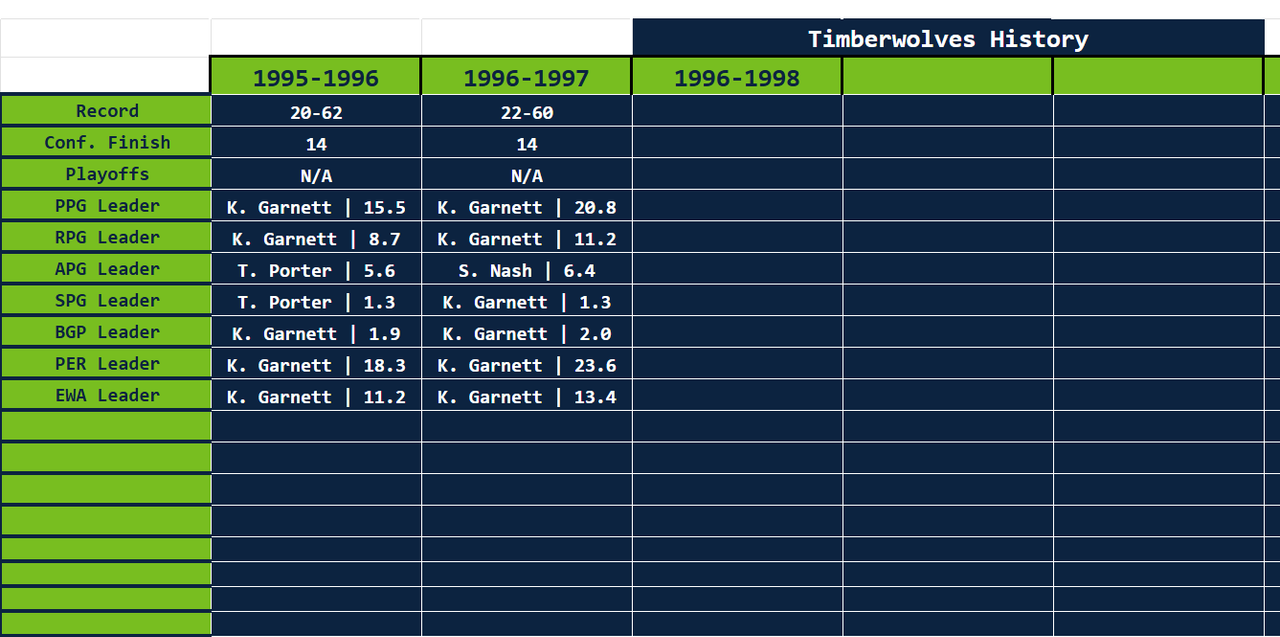
Timberwolves History

Image
Last edited by NaturalThunder87 on 15 Jul 2026, 18:11, edited 1 time in total.
User avatar

Topic author
NaturalThunder87
Posts: 160
Joined: 23 Mar 2026, 23:40

Saving KG: Rewriting T-Wolves History

Post by NaturalThunder87 » 14 Jul 2026, 16:54

Image
Image
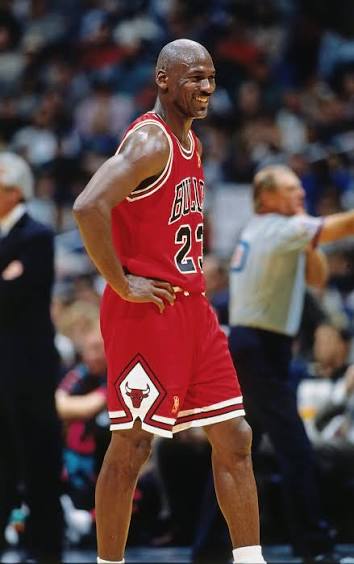
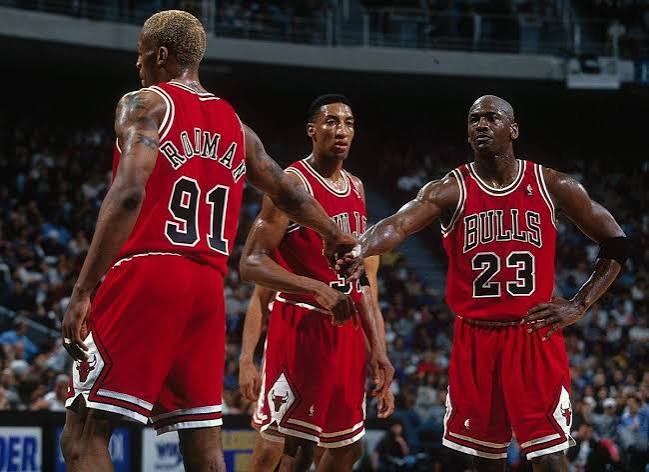
Michael Jordan posted a historic, best-ever 75-7 regular season record.
The 1995-96 season belonged to Michael Jordan and the Chicago Bulls.

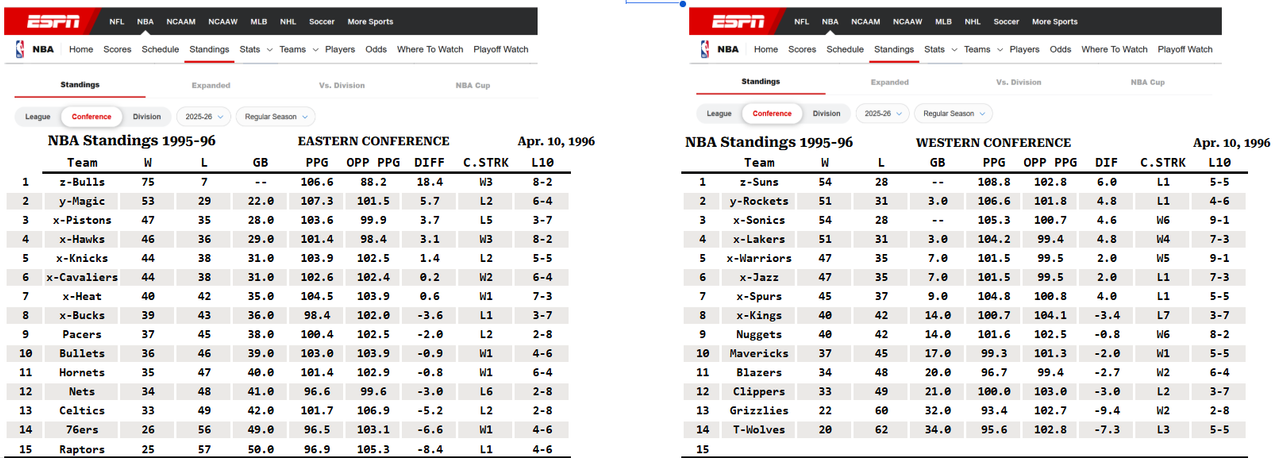
Fresh off Jordan's return the previous season, Chicago assembled the greatest regular season in NBA history, finishing 75-7 while have the third best scoring offense (106.6 PPG) and first in scoring defense by a wide margin (88.2 PPG). Their 18.4 point-differential per game was also easily an NBA all-time best. Jordan captured his fourth league MVP after averaging 28.3 points, 7.0 rebounds, 5.8 assists, and 2.5 steals per game, while Phil Jackson earned Coach of the Year honors. Chicago's near-unbelievable record included a 27-0 start to he season. The Bulls would go a more "normal" good 9-3 in their next 12 games, but followed that up with a 24-game win-streak.

The Eastern Conference offered little resistance. Orlando (53-29) remained a legitimate contender behind Penny Hardaway, while Detroit (47-35) and Atlanta (46-36) rounded out the conference's top four. Cleveland, New York, Miami, and Milwaukee completed the playoff field.

Out West, the race was far tighter. Phoenix claimed the conference's top seed at 54-28, narrowly edging Seattle via the tiebreaker despite both clubs finishing with identical records. Houston and the newly retooled Lakers each won 51 games, while Golden State and Utah finished at 47-35. Sacramento claimed the final playoff spot at 40-42.

Image
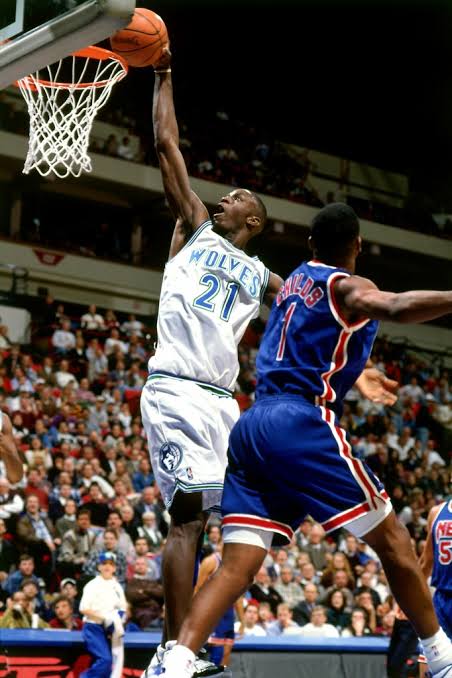
Kevin Garnett was a bright-spot as a rookie in an otherwise woeful T-Wolves season.


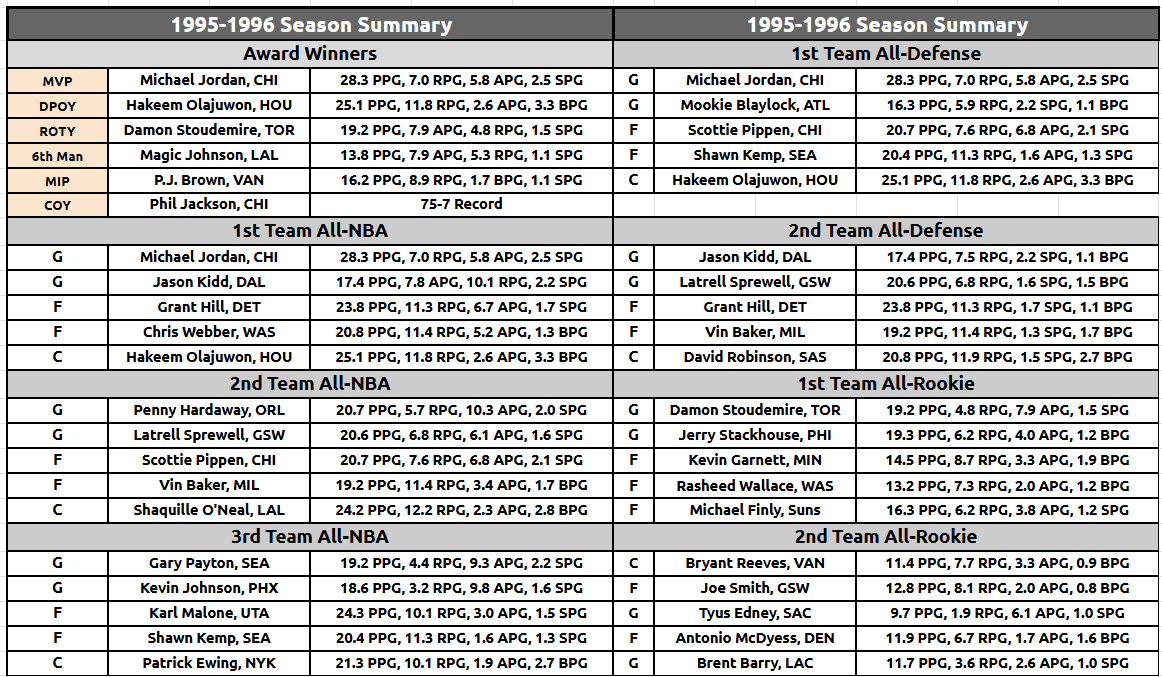
Minnesota endured another difficult season, finishing 20-62, but there were encouraging signs. Rookie forward Kevin Garnett quickly showed why he was considered one of basketball's brightest young talents, averaging 14.5 points, 8.7 rebounds, 3.3 assists, and 1.9 blocks while earning First Team All-Rookie honors. The record was disappointing, but the franchise finally had a cornerstone worth building around.

Image
The Chicago Bulls capped off their historic regular season with their fourth championship.


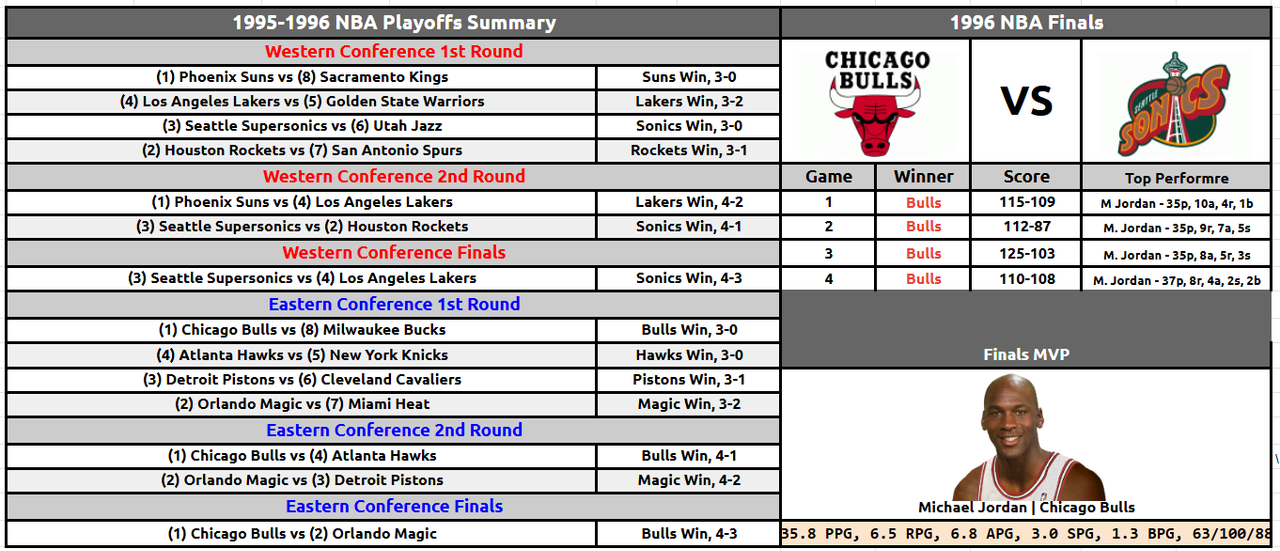
The postseason largely followed the regular season script, although not without drama. The Lakers upset top-seeded Phoenix in the Western Conference Semifinals before falling to Seattle in a seven-game Western Conference Finals. In the East, Orlando pushed Chicago to the brink, but the Bulls survived a seven-game conference finals to advance to the NBA Finals.

Chicago completed its historic campaign by defeating the Seattle SuperSonics in four straight games to capture the 1996 NBA Championship. Jordan was virtually unstoppable throughout the Finals, averaging 35.8 points, 6.5 rebounds, 6.8 assists, 3.0 steals, and 1.3 blocks while shooting an astonishing 63% from the field, 100% from three, and 88% from the free-throw line, earning Finals MVP honors.

Around the league, Hakeem Olajuwon claimed Defensive Player of the Year after anchoring Houston's defense, Damon Stoudamire was named Rookie of the Year in Toronto, Magic Johnson won Sixth Man of the Year following his return to the Lakers, and P.J. Brown earned Most Improved Player honors after a breakout season in Vancouver.

As one chapter closed with another Bulls championship, another was just beginning in Minnesota. Armed with the league's second overall pick in the upcoming draft and a franchise centerpiece in Kevin Garnett, the Timberwolves entered the offseason with hope that brighter days were finally on the horizon.


Image

Image

Image


Image

Image


The 1996 NBA Draft ushered in a new era for the league before Commissioner David Stern had even announced the first selection.

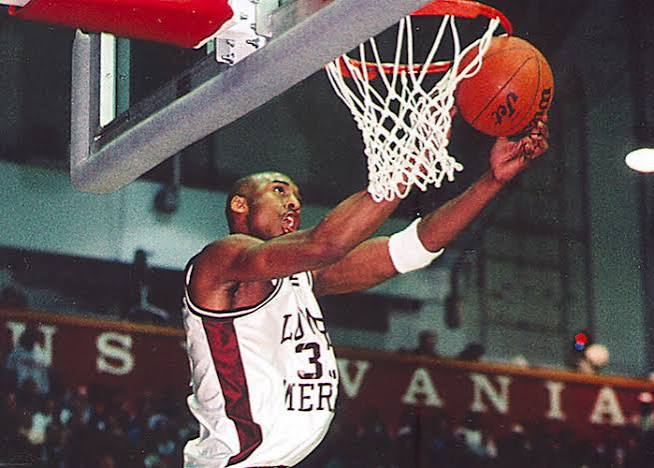
Holding the No. 1 overall pick, the Cleveland Cavaliers made history by selecting Kobe Bryant, making the 17-year-old the first player ever drafted No. 1 overall directly out of high school. Bryant's combination of size, athleticism, and limitless potential made him one of the most intriguing prospects in years, and Cleveland wasted little time betting that he would become the face of the franchise.

With Bryant off the board, the Minnesota Timberwolves were on the clock.

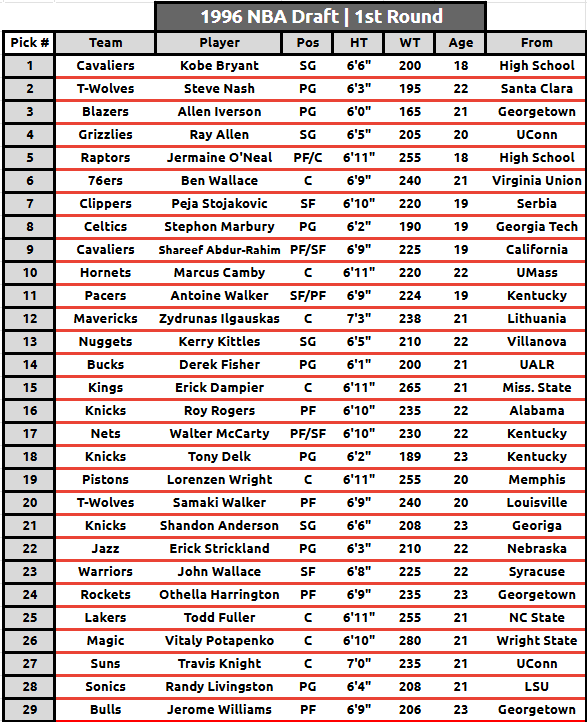
Rather than selecting a high-potential, explosive athlete, Minnesota opted for Steve Nash, the 22-year-old point guard from Santa Clara. Nash entered the draft as one of its biggest underdog stories. He lacked elite athleticism, played at a small West Coast program, and many scouts questioned whether his game would translate against NBA competition. The Timberwolves, however, saw something different. Minnesota's front office believes Nash possesses the one skill that can't be taught—an elite feel for the game. His vision, creativity as a passer, decision-making, and ability to control the tempo of an offense made him the ideal floor general to pair with second-year forward Kevin Garnett. The organization hopes Nash's playmaking and Garnett's unique all-around talent will grow together into one of the league's premier inside-out duos.

The remainder of the lottery featured no shortage of talent. Allen Iverson landed in Portland at No. 3, Ray Allen went fourth to Vancouver, and fellow prep star, 17-year-old Jermaine O'Neal, was selected fifth by Toronto. Philadelphia grabbed defensive standout Ben Wallace at No. 6, while the Clippers added Serbian sharpshooter Peja Stojaković. Boston selected Stephon Marbury eighth overall, Cleveland paired Bryant with Shareef Abdur-Rahim at No. 9, and Charlotte rounded out the top ten with Marcus Camby.

Minnesota closed out the first round by selecting Samaki Walker with the 20th overall pick, adding another young frontcourt piece to continue building one of the NBA's youngest and most intriguing cores.

Image
Last edited by NaturalThunder87 on 14 Jul 2026, 22:38, edited 4 times in total.
User avatar

Topic author
NaturalThunder87
Posts: 160
Joined: 23 Mar 2026, 23:40

Saving KG: Rewriting T-Wolves History

Post by NaturalThunder87 » 14 Jul 2026, 16:54

Image
1996-1997 Season Rundown
Image
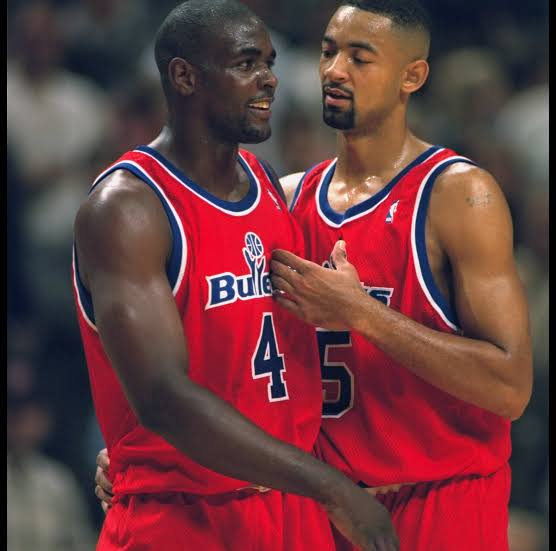
The formidable dynamic duo of Chris Webber and Juwan Howard led the Bullets to an NBA best 68-14 record.
Image

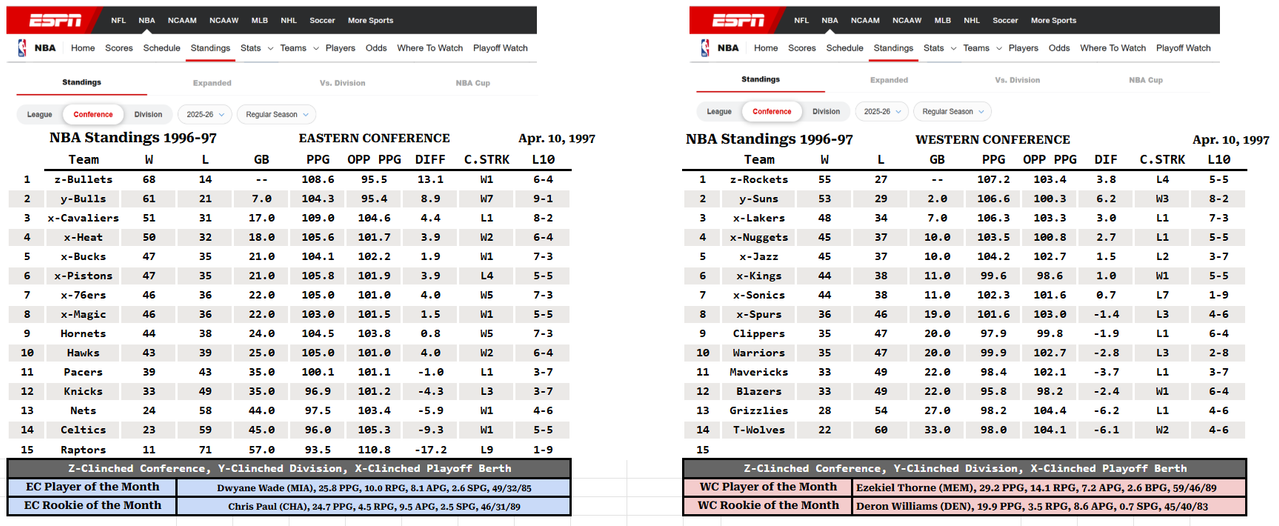
The 1996-97 NBA season saw an unexpected power emerge in the Eastern Conference as the Washington Bullets stunned the league with a dominant 68-14 record, finishing seven games clear of the defending champion Chicago Bulls. Washington's rise was fueled by one of the NBA's most talented young frontcourts. Chris Webber blossomed into a bona fide superstar, averaging 20.8 points, 10.8 rebounds, and 5.5 assists per game while finishing third in MVP voting. Juwan Howard continued his All-NBA caliber play with 21.3 points and 9.6 rebounds per contest, good for a fifth-place MVP finish, while second-year forward Rasheed Wallace added 15.6 points, 7.3 rebounds, and 1.4 blocks to give the Bullets arguably the league's deepest collection of young frontcourt talent. Despite Washington's dominance, the Bulls remained a major championship threat. Chicago overcame injuries that sidelined Scottie Pippen for 26 games, Michael Jordan for 16, and Ron Harper for 27, still finishing 61-21 before reminding everyone of their pedigree by winning their final 11 games of the regular season heading into the playoffs.

The Western Conference belonged to Hakeem Olajuwon and the Houston Rockets, who claimed the top seed at 55-27 behind another spectacular campaign from "The Dream." Olajuwon averaged 25.7 points, 12.2 rebounds, 3.8 assists, and 3.2 blocks per game, earning a second-place finish in MVP voting while anchoring one of the league's elite defenses. Behind Houston, however, the West was remarkably balanced. Phoenix secured the second seed at 53-29, but from there the standings tightened considerably, with just four games separating the third-place Los Angeles Lakers (48-34) from the seventh-place Seattle SuperSonics (44-38). Denver and Utah each finished 45-37, while Sacramento claimed the sixth seed at 44-38, creating one of the most competitive playoff races of the decade.

Image
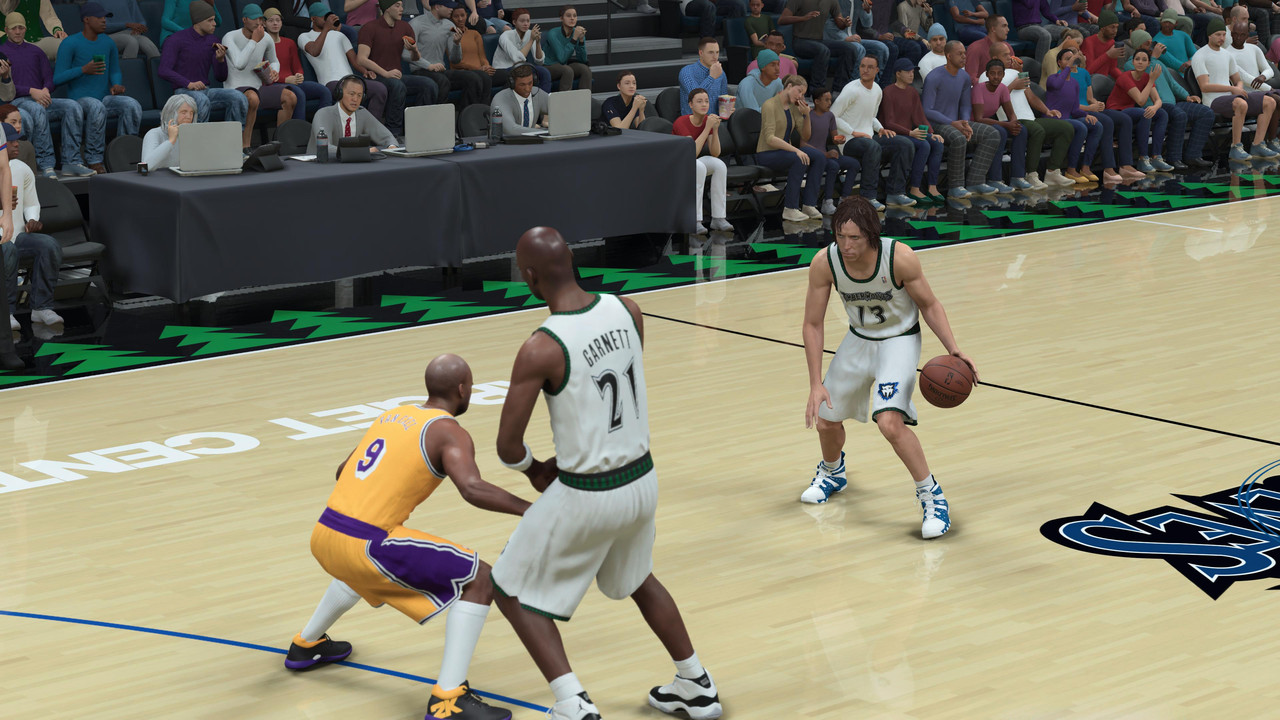
While the season was a woeful one, the future still looks bright in Minny thanks to the duo of Kevin Garnett and Steve Nash.

While the win-loss record showed only modest improvement, the 1996-97 season represented a significant step forward for the Timberwolves' long-term outlook. Minnesota finished 22-60, just two wins better than the previous year's 20-62 mark, but the franchise finally had legitimate building blocks to rally around. Kevin Garnett made the leap from promising teenager to bona fide NBA star in his sophomore campaign, earning his first All-Star selection while also being named Third Team All-NBA and Second Team All-Defense. The 20-year-old averaged 20.8 points, 11.2 rebounds, 3.8 assists, and 2.0 blocks per game, shooting an efficient 52% from the field while showing the early signs of becoming one of the league's most versatile players by knocking down 32% of his three-pointers and 80% of his free throws. His emergence gave Minnesota something it had never truly possessed before—a franchise cornerstone capable of competing with the league's elite.

The Timberwolves also found their point guard of the future in rookie Steve Nash. Initially brought along slowly, Nash seized the starting job over the final 55 games and never looked back, finishing with Second Team All-Rookie honors after averaging 13.3 points, 6.4 assists, and 2.3 rebounds per game. The Santa Clara product displayed the court vision, shooting touch, and leadership that convinced Minnesota it had found the perfect backcourt partner for Garnett, highlighted by a season- and career-high 32-point performance. Better yet, the Timberwolves were positioned to accelerate their rebuild. Thanks to a shrewd trade with the Celtics the previous season, Boston's disastrous 23-59 campaign delivered Minnesota an additional lottery selection. Combined with their own pick, the Timberwolves entered the 1997 NBA Draft armed with the fourth and sixth overall selections, giving the front office a golden opportunity to surround Garnett and Nash with even more young talent. More on that shortly.
Image
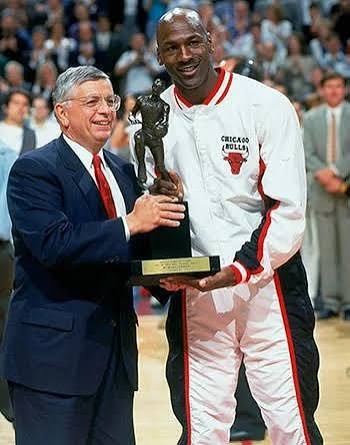
Michael Jordan took home his 5th MVP trophy after another stellar 1996-1997 campaign.
Image
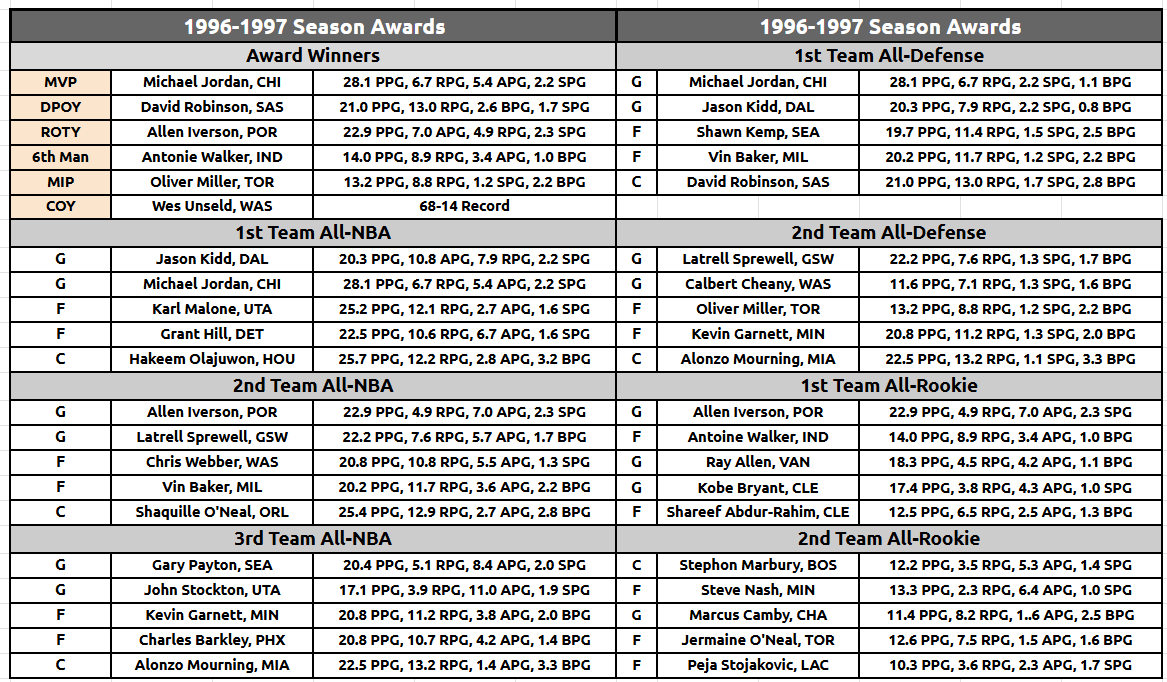
The league's individual honors reflected a fascinating blend of established legends and the NBA's next generation of stars. Michael Jordan captured his second consecutive MVP award—and the fifth of his illustrious career—after averaging 28.1 points, 6.7 rebounds, 5.4 assists, and 2.2 steals while leading an injury-riddled Bulls team to 61 wins. Hakeem Olajuwon finished as the MVP runner-up after carrying Houston to the Western Conference's best record, while Chris Webber's breakout campaign powered the surprising 68-win Bullets and earned him a third-place finish. David Robinson claimed Defensive Player of the Year behind another dominant two-way season, Allen Iverson exploded onto the scene by winning Rookie of the Year after averaging 22.9 points and 7.0 assists for Portland, Antoine Walker took home Sixth Man of the Year, Oliver Miller was named Most Improved Player, and Wes Unseld was the unanimous choice for Coach of the Year after orchestrating Washington's remarkable rise to the NBA's best record.

The All-NBA teams highlighted both the league's established hierarchy and its changing of the guard. Jordan, Jason Kidd, Karl Malone, third-year star Grant Hill, and Hakeem Olajuwon comprised a loaded First Team, with Hill's selection signaling his arrival among the league's elite. The Second Team featured rookie sensation Allen Iverson—a rare accomplishment for a first-year player—alongside Latrell Sprewell, Chris Webber, Vin Baker, and Shaquille O'Neal. Minnesota celebrated a pair of major milestones as Kevin Garnett earned his first All-NBA selection on the Third Team while also claiming Second Team All-Defense honors, validating his emergence as one of basketball's premier two-way forwards at just 20 years old. Rookie point guard Steve Nash capped an impressive debut campaign by earning Second Team All-Rookie honors after taking control of Minnesota's starting job midway through the season, giving the Timberwolves two foundational pieces recognized among the league's brightest young talents.

Image
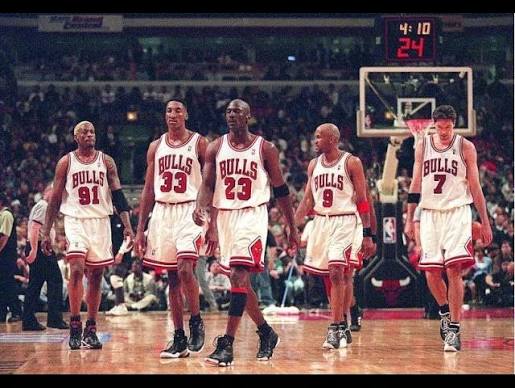
The Bulls did it again, taking home their second straight championship and their fifth overall.
Image

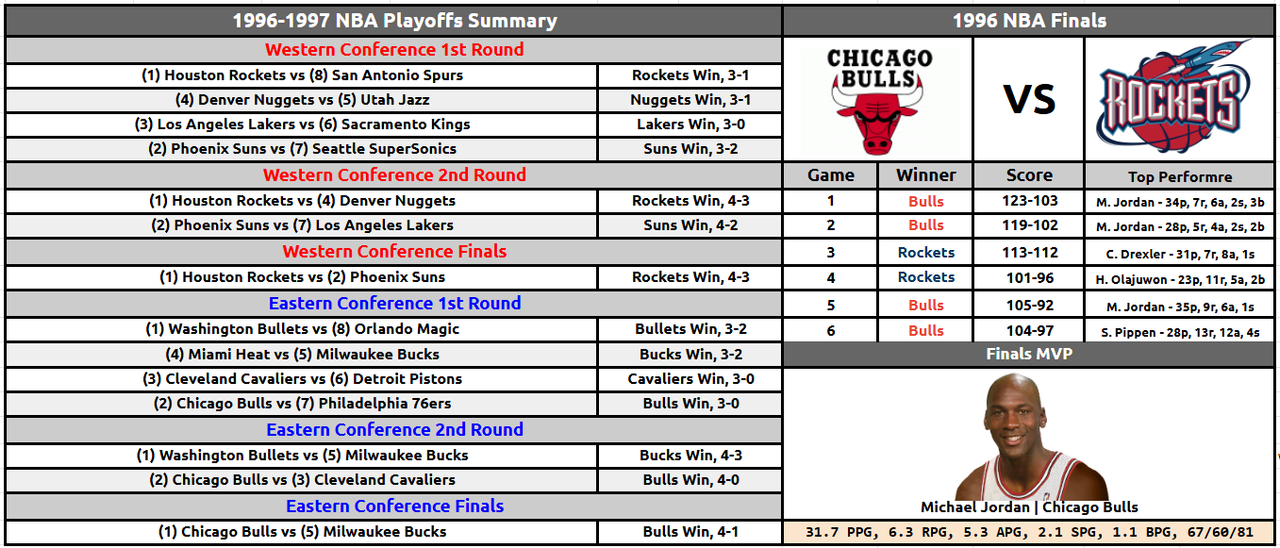
The 1997 NBA Playoffs delivered no shortage of drama, particularly in the Western Conference, where nearly every contender was pushed to the limit. Houston survived a pair of grueling seven-game series, first edging the upstart Denver Nuggets in the Western Conference Semifinals before outlasting the Phoenix Suns in another seven-game classic to capture the conference crown. Phoenix had earned its spot by surviving a five-game battle with Seattle before dispatching the Lakers in six games, while Denver's surprising run after upsetting Utah established the Nuggets as one of the West's rising teams. The Eastern Conference proved equally unpredictable. The 68-win Washington Bullets, owners of the NBA's best regular-season record, were stunned in the conference semifinals by the fifth-seeded Milwaukee Bucks in a hard-fought seven-game series, ending one of the greatest regular seasons in franchise history far earlier than expected. Chicago, meanwhile, wasted little energy, sweeping Philadelphia and Cleveland before disposing of Milwaukee in five games to reach a second straight NBA Finals.

The championship series ultimately showcased the era's two defining forces: Michael Jordan and Hakeem Olajuwon. Houston pushed the defending champions harder than any Eastern opponent had, with Clyde Drexler's 31-point, 8-assist effort stealing Game 3 and Olajuwon dominating Game 4 with 23 points, 11 rebounds, and five assists to even the series at two games apiece. But as they had so many times before, the Bulls found another gear. Chicago responded by winning the final two games, with Jordan pouring in 35 points in Game 5 before Scottie Pippen authored a brilliant 28-point, 13-rebound, 12-assist triple-double in the title-clinching Game 6. Jordan was named Finals MVP after averaging 31.7 points, 6.3 rebounds, 5.3 assists, 2.1 steals, and 1.1 blocks while shooting an astonishing 67% from the field, 60% from three-point range, and 81% from the free throw line. Chicago's victory secured its second consecutive NBA championship, and with the dynasty once again standing atop the basketball world, the conversation immediately shifted toward whether the Bulls could accomplish another historic three-peat in 1997-98.


Image

Image
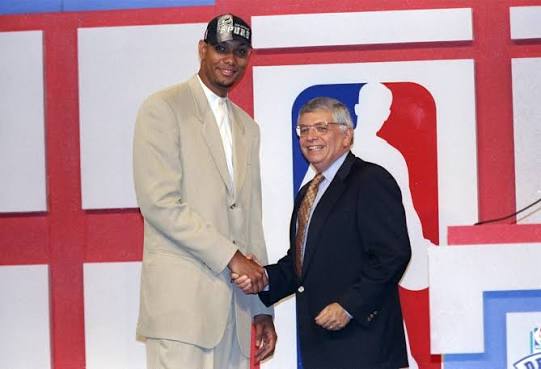
The Toronto Raptors wasted no time in selecting Wake Forest big man Tim Duncan with the #1 overall pick.


Image
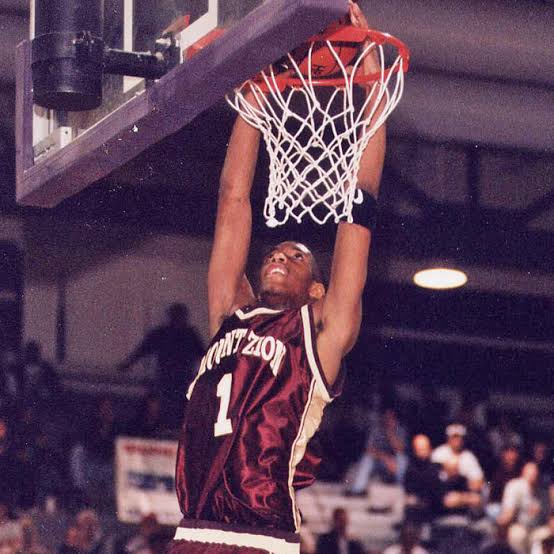
One year after Kobe Bryant was the first prep-to-pros prospect to go #1 overall in the draft, Tracy McGrady out of Mount Zion Christian Academy went #2 overall to the New Jersey Nets.

The 1997 NBA Draft opened with little suspense after the Toronto Raptors' disastrous 11-71 campaign earned them the top overall pick. Toronto selected Wake Forest superstar Tim Duncan, the consensus National Player of the Year and one of the most polished big-man prospects in years. Over four collegiate seasons, Duncan averaged 16.5 points, 12.3 rebounds, and 3.8 blocks per game, capping his career with a dominant senior season of 20.8 points, 14.7 rebounds, 3.2 assists, and 3.3 blocks while leading the Demon Deacons to national prominence. The New Jersey Nets followed by making history of their own, selecting Mount Zion Christian Academy phenom Tracy McGrady with the second overall pick. McGrady became the second-highest drafted high school player ever, following Kobe Bryant's groundbreaking selection at No. 1 just one year earlier. The 6-foot-8 swingman entered the league with enormous expectations after averaging an astounding 27.5 points, 8.7 rebounds, 7.7 assists, 2.8 steals, and 2.0 blocks during his senior season.
Image
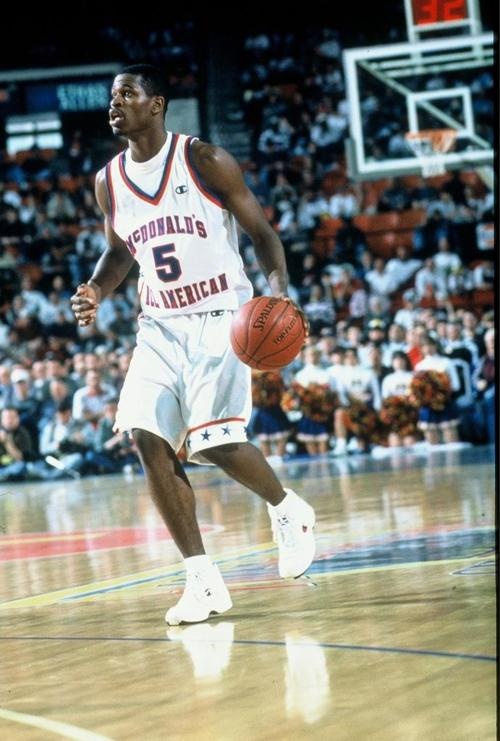
Minnesota's first selection (#4 overall) Stephen Jackson participating in the 1996 McDonald's All-American game where he led his team in scoring with 21 points.
Image
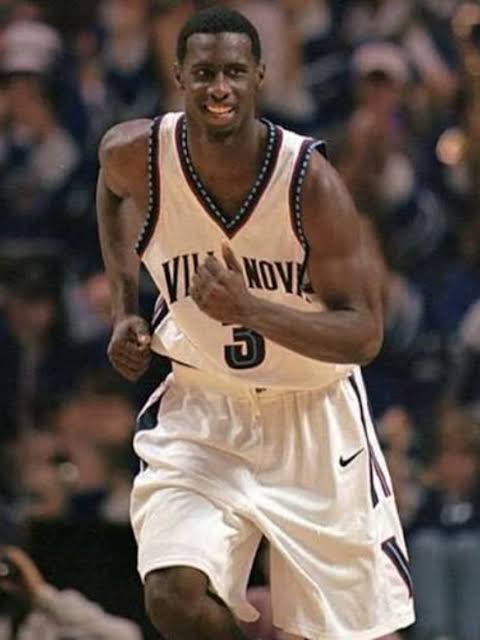
The T-Wolves second first round pick (#6 overall) was Tim Thomas who was named Big East Freshman of the Year in his lone college season at Villanova.

No franchise entered draft night with more flexibility than the Minnesota Timberwolves. Thanks to a shrewd trade with Boston the previous year, Minnesota owned both the fourth and sixth overall selections, giving the front office an opportunity to accelerate its rebuild around Kevin Garnett and Steve Nash. At No. 4, the Timberwolves rolled the dice on ultra-talented wing Stephen Jackson. Although Jackson never played a game at Butler County Community College after being ruled academically ineligible at Arizona, his reputation as one of the nation's premier prep prospects never faded. He had been the leading scorer for his team in the 1996 McDonald's All-American Game, sharing the spotlight with future NBA stars Kobe Bryant and Jermaine O'Neal. Two picks later, Minnesota added another versatile weapon by selecting Villanova forward Tim Thomas. A 6-foot-10 forward with guard skills, Thomas averaged 16.9 points, 6.0 rebounds, 2.1 assists, and 1.8 steals during his lone collegiate season while leading the Wildcats to a 24-10 record and an NCAA Tournament appearance. Between Garnett, Nash, Jackson, and Thomas—all 20 years old or younger—the Timberwolves suddenly possessed one of the NBA's most intriguing young cores, signaling that their rebuilding phase might finally be giving way to something much bigger.
Last edited by NaturalThunder87 on 15 Jul 2026, 17:17, edited 2 times in total.
User avatar

redsox907
Posts: 5769
Joined: 01 Jun 2025, 12:40

Saving KG: Rewriting T-Wolves History

Post by redsox907 » 14 Jul 2026, 17:16

:bigticket:

lets get it
User avatar

Topic author
NaturalThunder87
Posts: 160
Joined: 23 Mar 2026, 23:40

Saving KG: Rewriting T-Wolves History

Post by NaturalThunder87 » 15 Jul 2026, 18:36

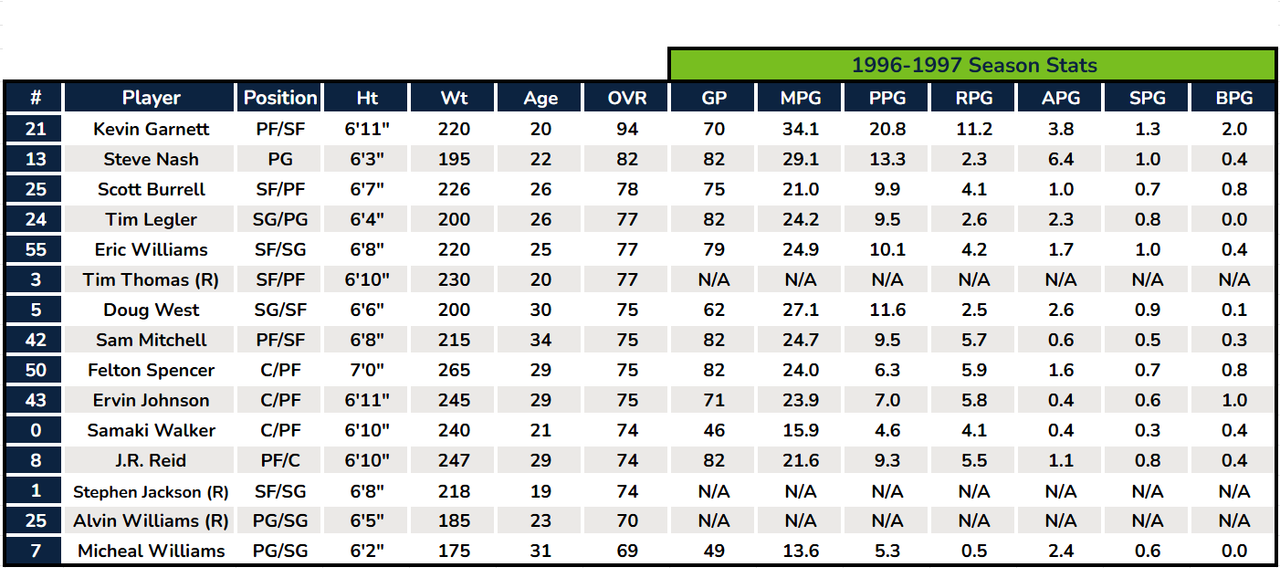
1996-1997 Minnesota Timberwolves Season Preview

Image

Since their inception for the 1989-1990 season, the Timberwolves have not held a clear vision. The dawn of each season has been a mix of bleak hope and microcosmic optimism. In their mere eight season of existence, the Timberwolves have averaged a woeful 21 wins and 61 losses per season. Their best season was a slightly-better-than-meh 29-53 in the 1990-1991 season. They have zero playoff appearances to their name. To say things have been bleak in Minneapolis is a great understatement.

However, due to the emerging brilliance of two-way forward Kevin Garnett and the flashes of basketball poetry from floor general Steve Nash, the 1997-98 season marks a turning point for the Minnesota Timberwolves. For the first time in franchise history optimism in Minneapolis isn't rooted solely in potential. It's rooted in a clear vision. After stumbling to a 22-60 record a year ago, the Timberwolves finally appear to have the foundation every rebuilding franchise covets: a bona fide superstar, a franchise point guard, and a front office committed to building the right roster around them, and equitable player-capital that could potentially be turned into future draft capital. The rebuild isn't finished, but it is no longer in its infancy.

Everything begins with Kevin Garnett. Entering just his third NBA season at 20 years old, Garnett has already become one of basketball's premier two-way players. Last season, he averaged 20.8 points, 11.2 rebounds, 3.8 assists, and 2.0 blocks while earning his first All-Star selection, Third Team All-NBA honors, and a spot on the Second Team All-Defense. His rare blend of size, athleticism, and skill has transformed him from an exciting prospect into one of the league's brightest young stars, and many around the NBA believe an MVP-caliber season is only a matter of time.

Alongside Garnett is another cornerstone. Rookie point guard Steve Nash exceeded every expectation after taking over the starting job for the final 55 games of the 1996-1997 campaign. Nash averaged 13.3 points and 6.4 assists while earning Second Team All-Rookie honors. The Santa Clara product may lack elite athleticism, but his vision, basketball IQ, and outside shooting make him the perfect floor general to maximize Garnett's unique talents. Together, Garnett and Nash have given Minnesota something it has never had before: a legitimate young star duo capable of growing together for years.

General manager Kevin McHale doubled down on that foundation during the 1997 NBA Draft. Thanks to a savvy trade with Boston a year earlier, Minnesota entered draft night holding both the fourth and sixth overall picks. At No. 4, the Timberwolves selected ultra-talented wing Stephen Jackson. Although Jackson never played a game at Butler County Community College after academic issues prevented him from suiting up at Arizona, his reputation as one of the nation's elite high school prospects never faded. He was the leading scorer in the 1996 McDonald's All-American Game, sharing the floor with future NBA stars Kobe Bryant and Jermaine O'Neal. Two picks later, Minnesota added Villanova forward Tim Thomas, a silky-smooth 6-foot-10 combo forward with guard skills who averaged 16.9 points in his lone collegiate season. His ability to shoot from the perimeter, handle the basketball, and create mismatches gives the Timberwolves another versatile piece alongside Garnett.

Minnesota wasn't finished adding talent. In the second round, the Timberwolves selected Villanova point guard Alvin Williams, reuniting him with Thomas after the pair helped lead the Wildcats to a 24-win season. While Williams projects as a backup behind Nash, his toughness, defense, and steady decision-making give Minnesota quality depth at the point guard position.

McHale also addressed the roster through free agency, adding experienced veterans to complement one of the NBA's youngest cores. Scott Burrell arrives from Charlotte after averaging 9.9 points and 4.1 rebounds, bringing athleticism, defensive versatility, and reliable wing scoring. Tim Legler joins the Timberwolves after helping Washington reach 68 wins, providing one of the league's most respected outside shooting threats and another ideal fit alongside Nash's playmaking. Veteran big man J.R. Reid rounds out the newcomers after averaging 9.3 points and 5.5 rebounds with New York, giving Minnesota much-needed size, toughness, and experience in the frontcourt rotation.

Those additions reflect a philosophical shift within the organization. Previous Timberwolves teams simply accumulated young talent and hoped for internal improvement. This roster has been intentionally constructed. Garnett is the franchise centerpiece. Nash is the floor general. Jackson and Thomas provide athleticism and upside on the wings, while veterans like Burrell, Legler, and Reid offer stability and professionalism for one of the NBA's youngest locker rooms.

Of course, expectations should remain measured. Garnett is still only entering his third season. Nash has less than a full season as an NBA starter. Jackson and Thomas have yet to play a professional game, and the Western Conference remains as unforgiving as ever. Hakeem Olajuwon's Rockets are the defending Western Conference champions. Phoenix remains among the elite, and the Lakers continue to ascend behind their young core. Denver, Utah, Sacramento, and Seattle all expect to be in the playoff hunt, leaving little margin for error.

Still, the standard in Minnesota has changed.

A year ago, success meant discovering whether Garnett could become a franchise player and whether Nash belonged as an NBA starting point guard. Those questions have been answered. Now, the focus shifts toward translating promise into victories. A significant jump in the standings and meaningful contention for the franchise's first playoff berth would represent another major step forward.

The Timberwolves may not be ready to challenge for championships just yet, but for the first time since entering the league, they possess something every successful organization needs: a clear identity, a young superstar, a gifted point guard, promising lottery talent, and a supporting cast built to help them grow together. The rebuilding phase is over.

Now it's time to find out just how quickly this young team can rise.
Last edited by NaturalThunder87 on 15 Jul 2026, 19:04, edited 1 time in total.
User avatar

redsox907
Posts: 5769
Joined: 01 Jun 2025, 12:40

Saving KG: Rewriting T-Wolves History

Post by redsox907 » 15 Jul 2026, 18:44

totally missed the recaps earlier. Can't say I could have passed up the opportunity to pair AI with KG, but it makes sense giving KG someone with Nash's play making ability.

Captain Jack and KG on the same team seems bound to implode, but I think y'all can at least make some noise this season. Maybe not playoffs, but at least be in the conversation
User avatar

Topic author
NaturalThunder87
Posts: 160
Joined: 23 Mar 2026, 23:40

Saving KG: Rewriting T-Wolves History

Post by NaturalThunder87 » 15 Jul 2026, 19:16

redsox907 wrote:
15 Jul 2026, 18:44
totally missed the recaps earlier. Can't say I could have passed up the opportunity to pair AI with KG, but it makes sense giving KG someone with Nash's play making ability.

Captain Jack and KG on the same team seems bound to implode, but I think y'all can at least make some noise this season. Maybe not playoffs, but at least be in the conversation
You probably didn't miss them. I finally just got through updating my reserved post spots less than an hour ago.

And RE AI+KG: me too man...me too. Like I mentioned in the original post, my early childhood NBA fandom gravitated towards my favorite players instead of favorite teams. AI was a very close second to KG in regards to my fanaticism/loyalty in my school-age years. Sometime in the early 2000s, I talked my parents into getting me the KG 3s. A year or two or three later, I bought my second signature shoe: The Reebok Answer 8s.

Was a very tough decision, but I felt like pairing KG with a pass-first PG was more optimal. I'm hoping that either or both of Stephen Jackson and Tim Thomas can emerge as a consistent second scoring threat; and if neither quite gets there I can flip them for draft capital when they're young. I'm afraid my team is going to be too good to land a top 7-10 pick in the 1998 draft, but we'll see. We're still young, but KG might just be too good this year for us to win fewer than 30 games. I'm currently in the middle of a 1997-1998 sim. I plan on picking up and actually playing games and providing more micro-updates starting with the 1998-1999 season. This whole thing started with plans of getting through the '96, '97, and '98 draft classes.
User avatar

Topic author
NaturalThunder87
Posts: 160
Joined: 23 Mar 2026, 23:40

Saving KG: Rewriting T-Wolves History

Post by NaturalThunder87 » 15 Jul 2026, 20:25

1996-1997 Minnesota Timberwolves Season Preview

Image

The 1997-98 season marks a turning point for the Minnesota Timberwolves. For the first time in franchise history, optimism in Minneapolis isn't rooted solely in potential. It's rooted in a clear vision. After stumbling to a 22-60 record a year ago, the Timberwolves finally appear to have the foundation every rebuilding franchise covets: a bona fide superstar, a franchise point guard, multiple lottery picks, and a front office committed to building the right roster around them. The rebuild isn't finished, but it is no longer in its infancy.

Everything begins with Kevin Garnett. Entering just his third NBA season at 21 years old, Garnett has already become one of basketball's premier two-way players. Last season, he averaged 20.8 points, 11.2 rebounds, 3.8 assists, and 2.0 blocks while earning his first All-Star selection, Third Team All-NBA honors, and a spot on the Second Team All-Defense. His rare blend of size, athleticism, and skill has transformed him from an exciting prospect into one of the league's brightest young stars, and many around the NBA believe an MVP-caliber season is only a matter of time.

Alongside Garnett is another cornerstone. Rookie point guard Steve Nash exceeded every expectation after taking over the starting job for the final 55 games of the season, averaging 13.3 points and 6.4 assists while earning Second Team All-Rookie honors. The Santa Clara product may lack elite athleticism, but his vision, basketball IQ, and outside shooting make him the perfect floor general to maximize Garnett's unique talents. Together, Garnett and Nash have given Minnesota something it has never had before: a legitimate young star duo capable of growing together for years.

General manager Kevin McHale doubled down on that foundation during the 1997 NBA Draft. Thanks to a savvy trade with Boston a year earlier, Minnesota entered draft night holding both the fourth and sixth overall picks. At No. 4, the Timberwolves selected ultra-talented wing Stephen Jackson. Although Jackson never played a game at Butler County Community College after academic issues prevented him from suiting up at Arizona, his reputation as one of the nation's elite high school prospects never faded. He was the leading scorer in the 1996 McDonald's All-American Game, sharing the floor with future NBA stars Kobe Bryant and Jermaine O'Neal. Two picks later, Minnesota added Villanova forward Tim Thomas, a silky-smooth 6-foot-10 combo forward with guard skills who averaged 16.9 points in his lone collegiate season. His ability to shoot from the perimeter, handle the basketball, and create mismatches gives the Timberwolves another versatile piece alongside Garnett.

Minnesota wasn't finished adding talent. In the second round, the Timberwolves selected Villanova point guard Alvin Williams, reuniting him with Thomas after the pair helped lead the Wildcats to a 24-win season. While Williams projects as a backup behind Nash, his toughness, defense, and steady decision-making give Minnesota quality depth at the point guard position.

McHale also addressed the roster through free agency, adding experienced veterans to complement one of the NBA's youngest cores. Scott Burrell arrives from Charlotte after averaging 9.9 points and 4.1 rebounds, bringing athleticism, defensive versatility, and reliable wing scoring. Tim Legler joins the Timberwolves after helping Washington reach 68 wins, providing one of the league's most respected outside shooting threats and another ideal fit alongside Nash's playmaking. Veteran big man J.R. Reid rounds out the newcomers after averaging 9.3 points and 5.5 rebounds with New York, giving Minnesota much-needed size, toughness, and experience in the frontcourt rotation.

Those additions reflect a philosophical shift within the organization. Previous Timberwolves teams simply accumulated young talent and hoped for internal improvement. This roster has been intentionally constructed. Garnett is the franchise centerpiece. Nash is the floor general. Jackson and Thomas provide athleticism and upside on the wings, while veterans like Burrell, Legler, and Reid offer stability and professionalism for one of the NBA's youngest locker rooms.

Of course, expectations should remain measured. Garnett is still only entering his third season. Nash has less than a full season as an NBA starter. Jackson and Thomas have yet to play a professional game, and the Western Conference remains as unforgiving as ever. Hakeem Olajuwon's Rockets are the defending Western Conference champions. Phoenix remains among the elite, and the Lakers continue to ascend behind their young core. Denver, Utah, Sacramento, and Seattle all expect to be in the playoff hunt, leaving little margin for error.

Still, the standard in Minnesota has changed.

A year ago, success meant discovering whether Garnett could become a franchise player and whether Nash belonged as an NBA starting point guard. Those questions have been answered. Now, the focus shifts toward translating promise into victories. A significant jump in the standings and meaningful contention for the franchise's first playoff berth would represent another major step forward.

The Timberwolves may not be ready to challenge for championships just yet, but for the first time since entering the league, they possess something every successful organization needs: a clear identity, a young superstar, a gifted point guard, promising lottery talent, and a supporting cast built to help them grow together. The rebuilding phase is over.

Now it's time to find out just how quickly this young team can rise.
Post Reply